Your Merch Table Is Talking Behind Your Back
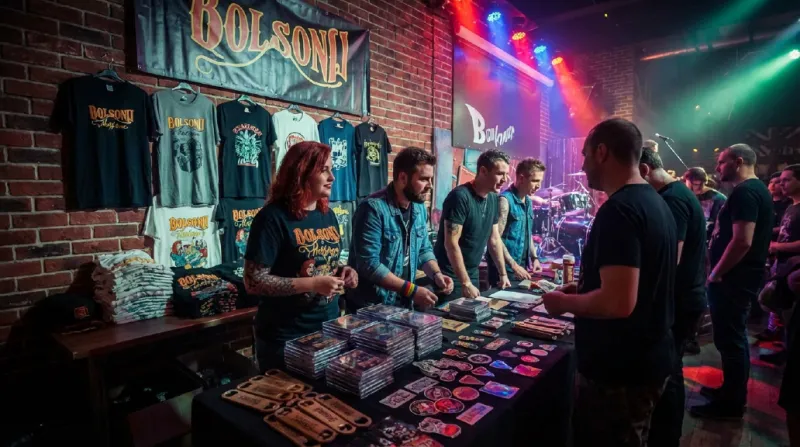
Photo: band merch table vinyl records t-shirts indie concert venue, via clipart-library.com
There's a moment every night before doors open when the venue is empty except for the smell of beer that hasn't been spilled yet. That's when I set up my merch table. And I'm telling you, after a decade of doing this, I've realized something slightly uncomfortable: by the time I play my first song, half the room has already made up its mind about me. Not from the music. From the table.
The Table Is a Handshake
Think about it. When an industry person, a booking agent, or just a curious stranger wanders past your setup, they're reading it like a résumé. A card table with a laptop propped on a phone displaying a Cash App QR code says something very different than a table with a tablecloth, a handwritten sign, and a vinyl copy of your record sitting under a clip light.
Neither one is wrong. But one of them says "I've thought about this" and the other says "I have not."
I learned this the hard way in a dive bar outside Columbus. I had a duffel bag of shirts, a shoebox of cash, and the confidence of a guy who figured the music would do the talking. It did not. I sold three shirts, two to the same person, and watched a guy who I'm pretty sure was a talent buyer walk past my table, glance for two seconds, and keep moving. My set was fine. My table was a shrug.
Layout: The Three-Second Rule
You get about three seconds of someone's attention as they walk by. So the table needs to answer three questions instantly: Who is this? What's good? Where do I give money?
Here's what's worked for me:
- Height beats flat. Anything lying flat on the table is invisible. Use a small rack for shirts, prop records upright, put your best item at eye level. Crate it, box it, stack it — just get it off the surface.
- One hero item. Don't spread everything evenly like a yard sale. Lead with your best seller or your weirdest item. Everything else supports it.
- Pricing you can read from four feet away. A small chalkboard sign with three prices does more than a shoebox of hand-scribbled tags. If people have to ask what things cost, you've already lost about half of them, because asking is social risk and most people avoid it.
- The signup sheet lives at the edge. Email list signups belong where the hand naturally lands — closest to where people approach. A pen attached to the clipboard with actual string. Yes, actual string. People steal pens like it's a national pastime.
Pricing Psychology, or Why $25 Beats $20
I fought this for years because it felt gross. But $20 shirts read as cheap and $25 shirts read as legitimate, and the weird part is people buy the $25 one more often. It's not a scam — it's signaling. Your fans don't want to support a hobby. They want to support an artist.
Also: bundle everything. Shirt plus record for a single price. Poster plus anything. Bundles raise your average sale by a ton and they remove the decision-making that makes people stand there frozen and then walk away. Decision fatigue is real, even at a merch table, even after two beers.
Cash and card, always. Square reader, Venmo, whatever — but keep cash change, because there's always someone with a twenty and no patience for a QR code that won't load in a basement with the Wi-Fi of a submarine.
The One Weird Item
Every artist I know who's any good at merch has one item that makes no sense and sells out every night. Mine started as a joke: bottle openers with my album art stamped on them. Cost me about two bucks each from a shop in Texas. I brought thirty on tour as a gag.
They outsold the shirts.
Here's why I think it worked: everyone already owns shirts. Nobody owns you-shaped merch. A bottle opener is cheap enough to be an impulse buy, useful enough to not feel wasteful, and weird enough to start a conversation — which is the whole point. Stickers work too, especially free ones. A sticker on a laptop or a water bottle is a walking ad that costs you forty cents. Some of my most loyal fans found me because they saw a sticker on a stranger's cooler at a campground in Michigan.
What the Pros Are Actually Looking At
A friend of mine who books rooms around the Southeast told me once that when she checks out a new act, she watches the merch table during the set. Not the stage — the table. Are people walking over mid-set? Is there a line? Is the artist working it after the show instead of hiding by the green room?
Because here's the real secret: the table isn't about money. It's about evidence. A table where fans are buying things is proof that you have fans. A signup sheet with actual names on it is proof you can build an audience in a new town. That's what gets you the booking, the opening slot, the festival reply that isn't a form letter.
So after your set, get behind that table. Talk to every single person who comes up. Learn one name. Remember one face. The person buying your $25 shirt tonight is the person bringing five friends to the next show, and the one after that.
Your Homework
Next gig, do four things. Cover the table — even a thrifted bedsheet looks intentional. Make one sign with your name and three prices. Bring one item under $10 that isn't a shirt. And stand behind the table before your set, not just after, so the early crowd meets a person instead of a pile of hoodies.
Your music gets you on the stage. But your merch table? That's what gets you back.