Hoodies Paid for My Album: Confessions of a Trunk-Full-of-Tees Economy
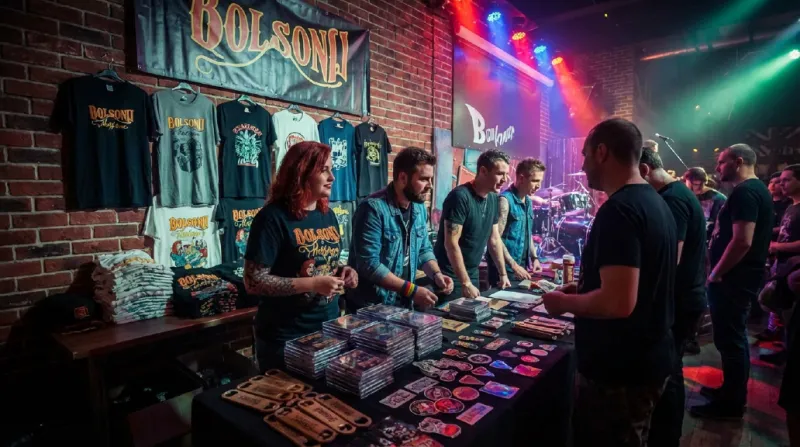
Photo: band merchandise table t-shirts at indie music venue, via www.stageportal.gg
Let me tell you about the most important business meeting of my career. It happened at a gas station outside Tulsa, somewhere around midnight, with a guy who bought two large tees and a koozie.
That's not a joke. That's the economy I actually live in.
The Streaming Check That Inspired This Whole Thing
Every independent artist has that one moment where the illusion cracks. Mine was a quarterly streaming statement that landed at $61.42. Sixty-one dollars. For a song that had actual humans singing it back to me at shows in three different states.
I did the math on my phone in the passenger seat while my drummer slept: at that rate, recording my next album would take roughly 340 years, assuming Spotify's mood held steady.
Meanwhile, in my trunk, I had forty shirts I'd printed at a shop in Nashville for about $6 a piece. I'd been selling them for $25. You don't need an MBA to see which revenue stream was doing the heavy lifting.
Why Fans Buy Shirts and Not Streams
Here's the thing nobody says out loud: a stream is invisible. A hoodie is a billboard with a heartbeat.
When someone buys your merch, they're not really buying cotton. They're buying membership. They're saying "I was in that room" or "I want to be the person who found this band first." That's a completely different psychological transaction than clicking play, and it's why a $30 hoodie feels like a fair deal while $10 a month for unlimited music feels like a ripoff to the same person.
Once I internalized that, my whole approach changed. I stopped designing shirts as an afterthought and started treating them like the product they actually were.
Designs That Actually Move
I've made every mistake, so let me save you the tuition:
- Nobody wants your face on a shirt. I don't care how good the photo is. People will wear a cool phrase or a striking graphic. They will not wear your headshot to the grocery store.
- The design should work even if someone doesn't know you. My best seller is a shirt with a lyric fragment and a simple line drawing. Strangers at truck stops have asked about it. That's free marketing wearing a size medium.
- Black shirts sell. Always. I don't make the rules. I've watched a heather gray design sit for a year while the same art on black sold out in six weeks.
- One design, done well, beats five designs, done okay. Early on I'd print five mediocre options and watch them all move slowly. Now I do two strong designs per run and they both move.
The Inventory Math (Bring a Calculator)
Tour merch is a logistics problem disguised as a vibe. Here's the formula I use now:
Never bring more units than you can realistically sell based on crowd size, not ticket count. A 200-cap room might mean 40 people walk past your table, and maybe 10 buy something. If I've got 60 shirts in the van, I've misallocated my money.
My current ratio for a standard club show: 20 tees, 8 of my best design, 12 of the secondary. Ten hoodies if it's below the Mason-Dixon line in winter or above it basically anytime. A stack of stickers at $2 a pop, because stickers are the gateway drug of merch.
The hoodie is the profit engine. It costs me maybe $18-22 to produce and sells for $55-60. That's a $35+ margin on a single item. Two hoodies and I've covered the night's gas. Three and I'm eating real food instead of gas station sushi.
The Album Budget, Itemized
So how does a trunk full of cotton become a record? Here's the actual ledger from my last album:
- Studio time and engineering: $3,800
- Mixing and mastering: $1,500
- Session players: $600
- Artwork and design: $400
Total: roughly $6,300. Not nothing, but not label money either.
That came from about eleven months of shows, an online store drop, and one glorious week where a TikTok clip of mine did numbers I still don't understand and moved 90 shirts. Every hoodie, every $25 tee, every $2 sticker went into a separate account I literally named "The Record" in my banking app so I wouldn't raid it for a new pedal.
Every Hoodie Is a Vote
This is the part I want fans to understand, because it reframes the whole transaction: when you buy merch at a show, you're not buying a t-shirt. You're buying equity in the next thing.
That hoodie funds the studio day. The studio day makes the song. The song brings you back to the next show, where maybe you buy the vinyl. It's a closed loop, and unlike a streaming platform, none of your money disappears into a shareholder's pocket. It goes straight from your hands into an amp, a mic, a plane ticket, a record.
I've started telling this to crowds from the stage. Not as a guilt trip — as a thank you. "That shirt you're buying is the reason the next song exists." Because it's true, and because fans deserve to know where the money actually goes in 2025.
The Trunk Is Open
These days I've upgraded slightly — there's a card reader, a folding table that doesn't wobble, and a spreadsheet I actually maintain. But the principle hasn't changed since that Tulsa gas station.
The record label of the future isn't a building in Los Angeles. It's a trunk, a table, a design people actually want to wear, and a fan base that understands what they're really buying.
See you at the merch table. I'll be the one doing math.